Manufacturing Process
10 precision-controlled steps from log to finished panel — with imported European equipment and rigorous QC at every stage.
Log Debarking & Cutting
Selected eucalyptus and poplar logs are debarked and cross-cut to the required length. Logs are stored indoors to maintain optimal moisture content before processing.
Rotary Peeling
Logs are softened by steaming, then fed through rotary lathes to produce continuous veneer sheets of uniform thickness (1.5–3.5 mm). Precision peeling minimises waste.
Veneer Drying
Green veneer is dried in roller or jet dryers to reach a moisture content of 8–12 %. Consistent drying is critical for bonding strength and dimensional stability.
Glue Application
Adhesive (WBP phenolic, MR urea or ENF zero-formaldehyde) is applied uniformly to veneer surfaces using automated glue spreaders. Glue weight and spread are monitored continuously.
Cross-Laminated Assembly
Veneers are assembled with alternating grain directions (cross-lamination). An odd number of layers (3, 5, 7, 9…) ensures dimensional stability and prevents warping.
Cold Pressing
Assembled panels undergo cold pressing to ensure even glue distribution and initial bonding before hot pressing. Pressure is applied for 30–60 minutes.
Hot Pressing at 105–150 °C
Panels are hot-pressed at 105–150 °C under high pressure to cure the adhesive and achieve final bonding strength. Continuous press lines (imported from Europe) ensure uniform temperature and pressure.
Trimming & Edge Sealing
Panels are trimmed to final dimensions (1220 × 2440 mm or custom sizes) using precision saws. Edges are sealed with waterproof paint to prevent moisture ingress.
Sanding & Calibration
Both faces are sanded to achieve uniform thickness (±0.5 mm tolerance) and a smooth surface. Film-faced panels receive phenolic film overlay application at this stage.
Quality Control & Testing
Final QC: moisture content measurement, bonding strength test (boil test for WBP), formaldehyde emission test, visual inspection (no open knots, cracks or delamination) and thickness calibration.
8-Step Quality Control Protocol
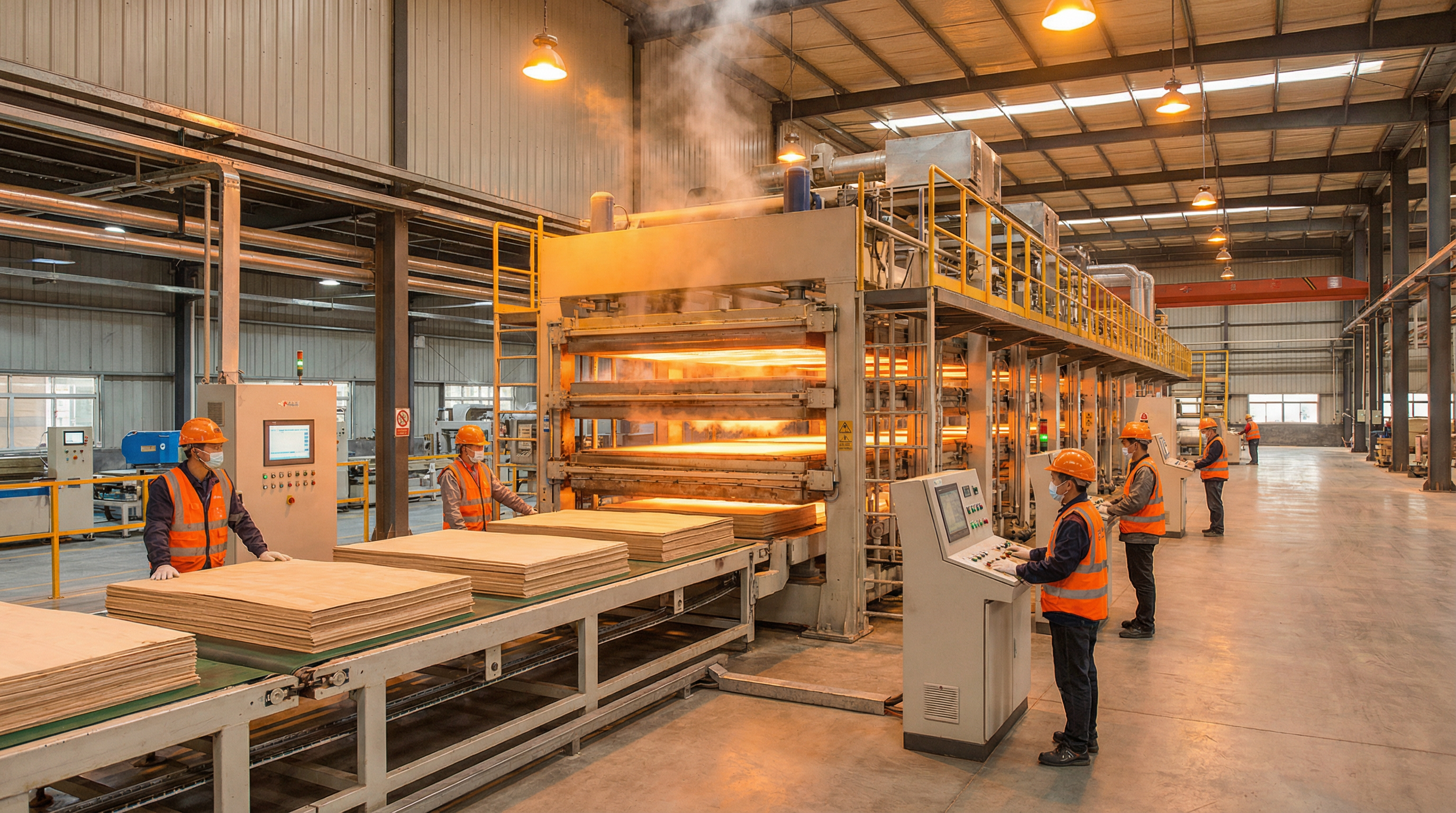
Imported European Machinery
TouZhong's factory partners operate imported continuous press lines and CNC machining centres sourced from Germany, Italy and Switzerland. These machines deliver consistent panel geometry, uniform glue distribution and precise thickness calibration that manual or domestic equipment cannot match.
- Continuous hot press lines (European origin)
- CNC edge-trimming saws
- Automated glue spreaders
- Roller and jet veneer dryers
- Precision sanding and calibration lines
- Automated film overlay lamination